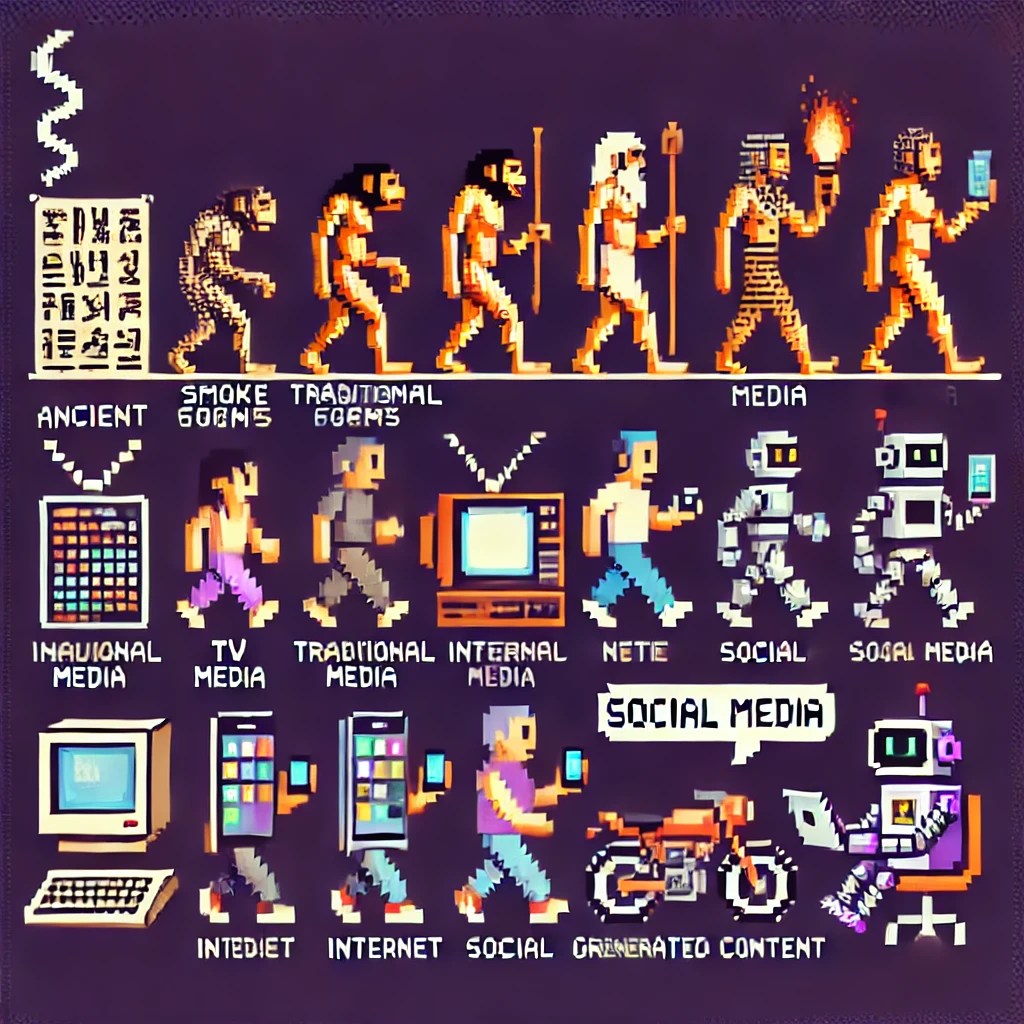
Ancient Media
Sharing stories and messages with an audience has been a fundamental human need since ancient times. From smoke signals and hieroglyphs to theatre acts and folklore songs, various formats have been used as means of communication across different cultures.
Traditional Media
Historically, traditional media outlets created content for specific audiences and distribution channels such as TV, newspapers, and magazines. Both content creation and distribution were expensive endeavours, limiting access to those with substantial resources.
The Internet
The Internet significantly lowered the costs of content creation and distribution. Anyone willing to set up their own website could create and share content with anyone who had an internet connection, democratising information dissemination.
Social Media
Social media platforms eliminated the need to set up a personal website by providing tools to create and share content easily. Distribution became based on personal networks built by following others and gaining followers. With just an internet connection, anyone could broadcast content to their network, with the primary cost being the time invested in creating content.
Interest-Based Content Platforms
The next evolution occurred at the distribution layer. Instead of users following people, content platforms began to discern users’ interests by recommending content and fine-tuning suggestions based on user interactions. This shift expanded the content pool for recommendations from hundreds (within one’s network) to millions (across the entire network) of items. Content creators evolved from being people within your network to interest-based creators catering to specific topics or niches.
AI-Generated Content
The latest iteration is powered by Large Language Models (LLMs). This technology reduces content creation costs for text and images, with video capabilities on the horizon. In many applications, content is now generated on the fly. For instance, search engines are evolving into answer engines, providing unique responses to queries instead of just links.
While the quality of user-generated content (UGC) and UGC enhanced with AI currently surpasses that of pure AI-generated content, the gap is closing. The quality of AI content is improving rapidly and is poised to exceed traditional UGC. It’s conceivable that within our lifetime, personalised movies will be created based on individual interests.
Tailored Content
Content can now be tailored specifically for individual users, making them the sole consumers. Instead of ranking content from an existing pool, content is generated uniquely for each user. This approach eliminates the cold start problem that content platforms face, as there’s no need for a pre-existing content pool or a content ranking algorithm to decide what to show users.
Moreover, because the content is personalised, users can choose the quantity, formats, styles, and subjects that interest them most.
Human Connection
Social networks possess a human warmth that makes them appealing. This warmth might come from a funny comment, a shared interest, or a friend’s post that brings happiness. The ability of a platform to evoke positive emotions contributes significantly to its success, and human-to-human interactions are the most common way to generate such feelings. It remains to be seen whether AI can replicate these emotional connections.
 Joan's Tech Stuff