Software engineering has expanded to solve new kinds of problems that weren’t practical before.
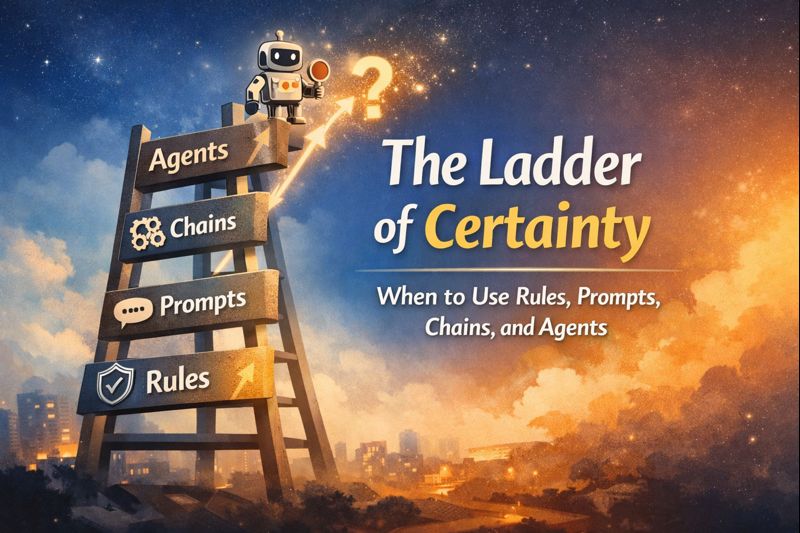
There are 4 ways to solve problems, depending on how certain we are about the path to success.
0) Hard rules / constraints
Use when you need deterministic outcomes. The result must be correct every time.
For example, bank transactions must always transfer the required amount with 100% certainty.
1) Single prompt
Use when “good enough” is acceptable and a human (or fallback) can cover the misses.
Best when quality is easy to judge quickly.
Example: Generate “related searches” suggestions for a query (good enough, quick human-like usefulness).
2) Chains (structured workflow)
Use when you can decompose the problem into known, repeatable steps and the order of steps is known upfront.
Reliability comes from checkpoints between steps.
Example: Interpret intent → retrieve results → rerank → generate a short answer snippet with citations.
3) Agents (open-ended exploration)
Use when you don’t know the steps upfront and the work requires discovery.
Best when the system must choose what to do next as it learns.
Example: “Help me research X” mode that iteratively searches, reads sources, refines queries, and updates the answer as it learns.
Key rule
As you move up the ladder (toward more uncertainty), you must increase verification: stronger evidence, clearer checks, tighter constraints.
 Joan's Tech Stuff